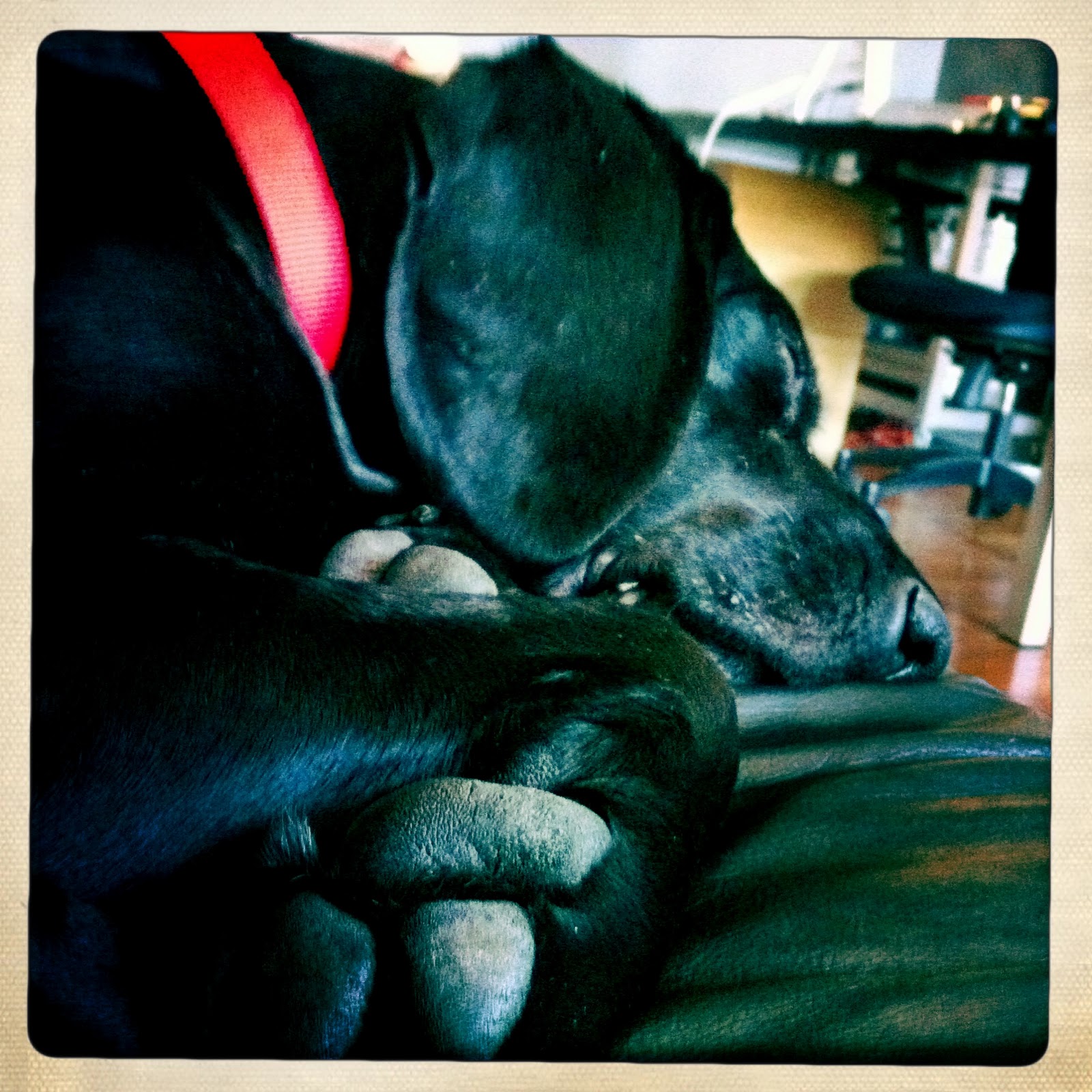
Wednesday, February 23, 2011

Missing Jake....

Day two of Jake's heartworm treatment.  No word from the vet which is a good sign.  Hopefully tomorrow he will be able to come home :)

"I miss Jake.."
Polaroid SX-70 Sonar with ND filter, Impossible PX-600 (batch 7/10)
Light/Dark wheel on max dark 
Developed using Impossible Hot/Cold Clip 4 minutes

Tuesday, February 22, 2011

An empty house again...

Well Jake is at the vet today starting his heartworm treatment.  He will be there for 3 days, then he comes home and has to be rested and prevented from exercising for 30 days while he recovers and his body slowly dissolves the dead worms.  It was almost a year between the day Tucker (my last dog, a chocolate lab) passed away and the day Jake came home with me.  It was a huge adjustment to coming home every day and not being greeted by a wagging tail.  Now after only a month I can't imagine not having Jake here.  It is only for a few days, but heartworms are serious and there is the very small chance Jake won't survive the treatment so that help makes this time apart a bit harder.

During the next month Jake will need to be monitored 24hrs a day on the off chance that complications arise.  I am so lucky that I have been able to arrange to work from home for most of that time.  My Father has also volunteered to stay with Jake on those few days that I need to go into work and I am sure I will be calling on my sister to puppy sit while I run errands.

I have decided to try and take at least one photograph each day to document this difficult time.  If I manage to stick to this I will post the results here.  I will use the new Impossible project films and use this time to test out the films and really see how the work.

This first image was taken with my Polaroid SX-70 Sonar, the film was Impossible PX-600 Silver shade (the second batch without the exploding chemical problem).  The light/dark wheel was set all the way to max dark.  The darkslide was taped over the ejection point to prevent the film from being exposed to light and then the film was placed in this hot/cold clip heated to the correct temperature range as indicated by the temperature sensitive indicators for approximately 4 minutes.  As you can see the film does well.  This was the first time I used the hot/cold clip for developing and it would seem that the film is much more evenly developed than sticking it in my pocket or warming it between my hands.  None of the splotches and white areas that are typical with this film can be seen.  Maybe I was just lucky, or maybe the pressure and even temperature of the clip helps.


"An Empty crate..."
SX-70 Sonar, Impossible PX-600 (batch 7/10)

Thursday, February 17, 2011

Iphontography, and Jake!

So I am sure it is not news to anyone reading this that cell phone photography is quite popular.  You may not be aware that many “photographers” look down on these type of images and can’t stand that some people claim to be photographers when all these use to create pictures is a cell phone.
Personally I find that sentiment funny and a bit elitist.  I suppose you could ask the deep philosophical questions, “What make a photographer?”  Some would answer anyone who shoots and develops their own film and makes traditional darkroom prints.  Some may say anyone who uses a fully manual capable camera and chooses the setting themselves.  I am sure you could ask any number of people and get varying answers from all of them.  Me I think a photographer is an artist who creates beautiful images.  We don’t care what type of brush or paint the great painters used why should we care what tools a “photographer” uses, right?  There are many great photographers that didn’t develop their own film, shoot on fully automatic, don’t make their own prints, shoot digital.  What really is the difference between a point and shoot and an expensive SLR shot on fully automatic?  Basically the cost.  Do “real photographers” use the auto settings on their fancy cameras? Hell yes they do.  When I shoot my automatic cameras I rarely shoot on anything other the Aperture priority mode where I select the aperture and let the camera select the shutter speed.  There are plenty of instances where I will even use the full auto setting because I know the camera will choose the settings I would want and allowing it to take care of that frees me up to frame the scene.
So I ask what does it matter if someone calls themselves a photographer if they use a cell phone camera?  Yes the “quality” of the images will be different (read in general worse by any measure) than a fancy SLR, yes there are limitations to what you can and can’t capture.  But so what, if that is the look and feel you want then a cell phone camera is the right tool to create your art.
What about editing your images? Anyone who knows me or has taken one of my classes knows that I am a firm believer that the art of photography is a two step process.  Step one is capturing the RAW information using your camera (either on film or as a digital file), the second is brining your vision to life by post processing (using the wet darkroom or something like Photoshop).  Cell phones these days offer a range of Apps that allow you to quickly and easily post process your image.  I see these as no different than more traditional darkroom or Photoshop methods.  Yes they are more automated, but that isn’t to say you can create stunning images without learning a lot about what the various apps can and can’t do.  Just like the wet darkroom you need to spend time making images to learn what the limits are for creating an image.  Now don’t get me wrong I am not saying anything you can do in the wet darkroom or Photoshop you can do on your iPhone, rather they are different ways you can create images, but both produce photographs and in the right hands both can create amazing art.
So my answer to the question “Can you be considered a photographer if you use a cell phone camera?” Is of course you can.  But your images will still be evaluated the same way as any other images created with any other camera.  Much like toy camera photography once you get past the awe that the images were created with “inferior” equipment and the coolness of the effects of the camera used the images still have to say something, tell a story, instill emotions in the viewer, make an impact.
Personally I like to try and make photography a part of my everyday life, I always have a camera on me even if I don’t take a single picture.  I am always looking for images and having a cell phone on me means I can grab something if I see it.  I have unintentionally started creating a series of images of people on public transportation. 

I also use my iPhone to capture images of my new rescue, Jake!  Jake is a 4 year old lab/hound mix and he has had a pretty rough life from what I can tell.  He came to me with heartworms, intestinal parasites, a cherry eye and a few pieces of either BB's or buck shot embeded in him.  He recoils from certain movements like he has been beaten, yet he still is so gentle and happy to meat anyone and everyone.  All he wants is for you to scratch his ears.  Since Jake is about to undergo heartworm treatment and will be required to be crated almost 24 hrs a day for th next month I will post these images in honor of him.  Please keep me and Jake in your thoughts as we go through this difficult time.  Heartworms are nasty creatures and treatment once a dog has them is pretty scary and requires what seems to me an almost inhumane confinement.  I did the research and understand why he needs to be kept calm and confined, I understand that it is what is best for him, but he won't understand.  He is just now recovering from the intestinal parasites he came with and is feeling energenic and desperately wants to play.  I have only had him for 4 weeks now, but already he is part of my family, it never ceases to amaze me how quickly they become part of the family.  How anyone could have treated Jake like they did and allowed him to get so sick is beyond me.


"Waiting for Jake to come home"
iPhone 4, Hipstamatic App


"Jake on his bed"
iPhone 4, Hipstamatic App


"Do i really get a bed all to myself?"
iPhone 4, Hipstamatic App


"Big Paws!"
iPhone 4, Hipstamatic App


"Napping on the couch!"
iPhone 4, Hipstamatic App


"Four Paws!
iPhone 4, Hipstamatic App


"I Love Duck!"
iPhone 4, Hipstamatic App

"Dad, why can't I go outside to play?"
iPhone 4, Hipstamatic App

Friday, February 11, 2011

China Town, San Fransisco...A great place for a nap!

Here is another image created on my recent trip to visit my sister in California.  Taken with my new Fujipet.  The original was color, but this one definitely works better in B&W!

 "Nap time!"
Fuijpet, Kodak Porta 400

A recent blog post by friend and photographer, Blake Stenning got me to thinking about the nature of my street photography and how I seem to be drawn to the solitary figure.  I wondering if I photograph people as solitary figures because I often feel like a lone individual especially while traveling.  Right now this feels like way to deep of a thought to follow on a Friday.  Enjoy the image and have a great weekend!

Friday, February 4, 2011

TOYCAM Best of 2010!

This week will be a short and sweet post.  First in case you hadn't heard the news Holga Inspire selected TOYCAM as one of it's 4 best toy camera photography book for 2010!  I think I speak for the whole book team when I say we are happy that the book has been so warmly received!

TOYCAM Best of 2010

Moving on, below find another image from my recent trip to San Fransisco.  Taken with my trusty Holga.  You really can't beat the Holga for an easy camera to carry around while on travel.  This image just goes to show you that with ISO 400 film you will have pretty good range of light levels you can shoot in.  Normally I load Ilford's HP5 into my trust Holgamods Holga with 2 apertures and I carry a 2 stop ND filter giving me 4 stops of shooting capability.  Here I shot wide open with no filter and you can see that I got some pretty good detail in the low light of the cafe.  With a bit of dodging and burning I was able to bring down the outside details and create some nice tones for this type of lighting.

 "Coffee Break"
Holga, Ilford HP5

Thursday, January 27, 2011

Photographer or camera collector?

So over the years I have realized that you can divide photographers in to two general categories; those that have a camera or two, and those that have 20+.  One phrase you will often hear if you take any kind of formal instruction is that “It’s not the camera, it’s the photographer”.  Basically a good photographer can create good photographs regardless of the equipment.  So the question can then be asked why would any photographer want or need more than a camera or two?
There are obvious reasons why some photographers don’t have an arsenal at their disposal.  Money comes to the top, if you don’t have the financial ability to purchase and maintain numerous cameras then you will use what you can afford.  Others develop a very specific style and find and stick to the equipment that allows them to realize their vision.  I could go on, but I really can’t talk from this side of the divide with any real knowledge as I fall very clearly on the other side of the divide.
There is where I admit I have a problem….I own around 30 cameras.  I own a Hasselblad 500C, Graflex 4x5, Razzle (an old Polaroid converted to 4x5), Nikon FM2N, around 10 Holgas (4-5 Holgmod Holga 120N’s, a 120S, a pinhole Holga, a Holgaroid, and a TLR Holga), about 5 Diana cameras and her clones, and 8 various Polaroid cameras (including a 180, SX-70 Sonar, SX-70, 600SE, and Big Swinger 3000), 2 Fujipet Thunderbirds, my one digital camera a Canon 50D, and various other toy cameras (Sprocket Rocket,  Ansco Pix Panorama or two).  These are just the cameras I own currently, over the years I have purchased, used, and resold easily 20-30 others.
So the question becomes why?  Why do I need/want more than a camera or two?  Why does anyone?  I can’t speak for anyone else, but I love cameras.  So part of the answer I am a collector of sorts.  Some of the cameras that have passed through my hands have been used as display pieces in my home.  But there is more to it than that.  I am an engineer by day, so I think cameras speak to that side of my brain.  There are so many different cameras, different ways a device can be designed to do the same thing that I enjoy holding them and learning to use them.  A fun result of this is I can usually pick up any camera and figure out how to use it without instructions in a few minutes.  This is less true for digital mainly because not nearly as many digital cameras have passed through my hands, plus figuring out the levers and dials of old film cameras is just easier, finding functions buried in a menu is just not as intuitive.
There is still more to the equation if you will.  Different cameras have different effects on the image.  Each design has it’s unique methods of capturing light and that leads to visible effects on the final image as well as the effects the physical design has on how you the photographer captures an image.  An easy example is the different between a pocket point and shoot and a large 4x5 view camera.  The view camera requires a tripod, the film is huge and takes up space and the camera requires that you take time to set it up, focus it, set the aperture and shutter speed.  This is long time consuming process and the equipment is not really portable so you can’t capture a fleeting moment that you pass on the street on your way to the bank like you could with that point and shoot.  Another easy example is a toy camera vs a “real” camera.  Toy cameras in general have cheap plastic lenses and little to no controls.  Images tend to have soft focus (if any at all), vignetting, light leaks, etc…These effects can lend an old feel to an image and even kind of a dream like feel.  You aren’t going to use a camera like this when you need sharp and precise focus.  So basically finding the right camera to assist you in capturing the image you want is important, and if you are an eclectic shooter like me this means you will want various types of cameras.
Then there is also the “cool” factor.  Some cameras are just cool and fun to have.  They may not be a camera I use often, but they are fun and sometimes they help me just get through ruts.  I may not be inspired to shoot anything, but how can I pass up the opportunity to walk around town running some instant film through my Big Swinger 3000?
Then there are the toy cameras I own.  It’s is actually typical to own multiple Holgas.  Some are used to tryout various hacks or alterations, but mainly having 2-3 in your bag allows you to shoot longer before having to reload film.  They are light weight so carrying a bunch around is easy.  I also tend to pick up a Diana or clone here and there simply because they aren’t made anymore and I know when the few I have die beyond repair I’ll want to have a few spares.
So I guess the simple answer is I just like cameras, and I am lucky to have been able to purchase a bunch that makes me happy.  I usually have a few on hand that haven’t been used yet and those provide great incentive to shoot when I don’t have any real inspiration or don’t feel like shooting for any of my ongoing projects.  Currently my list of cameras that I need to take out for their first spin are the Razzle, Sprocket Rocket, Holga pinhole.  I just ran my first few rolls through the Fujipet!
I guess I should note that in general my camera bag usually has the same equipment.  A holga or two, the hassi or Nikon, and about 60% of the time the digital.  So the vast majority of my cameras are used more for fun or for very specific reasons.  I could easily live with the Hassi, Nikon, Digital and a couple of Holgas and maybe one of my new Fujipets.  That’s not to say I’d give up any of the other cameras unless I really had to.


Left to Right, Top to Bottom: Fujipet Thunderbird, Razzle, Greflex Speedgraphic 4x5, Polaroid 180
SX-70 Sonar, Impossible PX600 (Batch 6/10)

Thursday, January 20, 2011

Art of the tourist take two

So a while back I wrote up a bit about my thoughts about taking pictures while on travel.  Mainly I focused on how if you practiced looking for interesting photographs in your everyday life it could help you create something special while traveling. Here is a link back to that post if you missed it:

art-of-tourist

Here is another fun tip for creating some unique travel images.  If you have ever really looked at the typical travel images people take you can pretty much sum them up this way "Some one the photographer knows in front of something supposedly interesting".  Pretty boring in general right?

One of my favorite techniques to use when shooting with my toy cameras, especially my Holgas is overlapping images.  The Holga (and most toy cameras) have a fully manual film advance that isn't tied into to the shutter.  In other words you don't have to advance fully to the next frame to be able to take the next shot so you can take a picture advance part way to the next frame and take another picture that overlaps the first.  You can do this for the entire roll of film if you wanted creating a very long image.  Typically I like to overlap around 3-5 frames, anything longer and you need some good photoshop and scanning skills to scan in the image in pieces and stitch it back together.

Typically I create panoramas of a wide scene this way, but it can be even more fun to overlap images of vastly different scenes or the same scene at different times. An example of the first can be seen in an old post here:

accidental-art

Here is my twist of the usual "Someone I know in front of something" image using the overlapping technique.  I also like to take "tourist" images in very mundane places, like in this case a bus stop.  That is probably more a reflection of how I like to travel, I don't really care about the fancy tourist places or museums.  I'd prefer to spend the day wandering the streets where the people actually live pretending for a day that I live there too.  All I do is look for great places to eat, and enjoy the sights and sounds of where ever I am.

Carolyn, Mike, and I - San Fransisco
Holga, Ilford HP5

For those of you familiar with the Holga here is my technique for creating consistent overlaps.
1. Remove the insert from your holga
2. Tape up the inside of your camera around the lens opening using non reflective black tape, I use gaffers tape.
3. Move the slider on the film counter window to 16 and shoot on every number.  When on 16 you are using the numbers for 6x4.5 images, but without the insert in you are create images slightly bigger than 6x6 so you will have a nice even overlap every time.
Notes: when you want to end an image you need to advance to the second number you see in the window so that you leave enough space to prevent an overlap.  So say you take your last shot and you start winding and see the number 9 in the window, advance to 10 if you want to start a new image.

Friday, January 14, 2011

Apparently the world is in color, who knew?

So every once and a while it's good to step out of your comfort zone.  Mine is clearly B&W photography.  I love everything about B&W images.  I love that they create a slight abstraction of the real world.  I love the rich gray tones you can create.  I love how easy you can create various moods.  Basically when I am photographing even with a digital camera I am seeing the world in B&W.  It's not that I am color blind, just that for some reason I have a sense for what images are going to work when converted to B&W.  There are other practical reasons, developing B&W film is very cheap so by shooting on B&W film and doing my own developing I can afford to shoot much more than if I decided to have a lab process my film.  This allows me complete control from the camera to the print.

So I hope I have convinced you that color is not my thing.  So often when I feel I need to step out of my comfort zone my first action is to shoot in color.  Now I can probably count on my fingers and toes the number of rolls of color film I have shot in my life so it is very rare that I shoot in color.  Even once I finally purchased a digital camera I have pretty much converted every image to B&W.  I find it very weird to look at the LCD screen on the digital and not seeing the image I see in my head.  I had to actually trust myself in the beginning that the image would work once I converted it :)

So for what ever reason when I went to visit my sister in San Fransisco I packed some color film and took my new Fujipet along with my trusty Holga.  I loaded the Fujipet with Color and the Holga with B&W.  Mind you I had only run 1 roll of film through the Fujipet, so not only was I using the dreaded color film, but I realy had no real feel for the camera yet and what film speed would be ideal.  I think most of us when we travel with our cameras we default to taking the cameras and film we are most comfortable with so we don't miss the chance to get some good pictures.  Strangely I have much more fun when traveling by trying totally new things, new cameras, new films, what ever.  It is freeing to allow myself to not really care if I got the shot.  When it works it seems all the more awesome because it is different from the usual look of my images.  In a way this difference from the usual look of my images can also enhance the feeling of a different place to me cementing for me the experience of visiting a new place.  When it doesn't work I don't really feel bad because I know I just need more time to figure out the new camera or film.

So here is my favorite image I created with my new camera, I hope you like it.

China Town, San Fransisco
FujiPet, Kodak Porta 400